
SEO vs. AEO: The 2026 Visibility Strategy Social Media Managers and Entrepreneurs Need

Updated: Aug 19

Search is no longer limited to a list of blue links. Your next customer may discover your business through Google, an AI-generated answer, ChatGPT, a social platform search bar, or a recommendation that combines information from several sources.
That shift has created a new priority for brands: combining search engine optimization (SEO) with answer engine optimization (AEO).
SEO helps your content become discoverable, understandable, and competitive in search results. AEO helps your expertise become easy to extract, trust, summarize, and cite in direct answers. The strongest visibility strategy uses both.
The short answer: SEO helps people find your page. AEO helps search and AI platforms understand when your page contains the best answer. You do not need two separate content strategies. You need one clear, credible, well-structured strategy designed around real customer questions.
Key takeaways
SEO and AEO work together. Strong AEO begins with solid SEO.
Publish direct answers, then add context, proof, examples, and next steps.
Build content around specific customer questions, not broad keywords alone.
Use consistent brand, author, service, and location information across your website and social profiles.
Add original experience so your content offers more than a generic AI summary.
Measure citations, qualified traffic, branded searches, leads, and sales, not rankings alone.
What is SEO?
Search engine optimization is the process of improving a website so search engines can crawl, understand, index, and rank its content for relevant searches.

Traditional SEO includes:
Search intent and keyword research
Helpful, original content
Descriptive titles and headings
Internal and external links
Fast, mobile-friendly pages
Image optimization and alt text
Technical crawlability and indexing
Local business information
Backlinks and brand authority
SEO remains essential because AI-powered search experiences still need to discover and evaluate online sources. Google states that its foundational SEO best practices continue to apply to AI Overviews and AI Mode, with no separate technical requirements for inclusion in those features (Google Search Central).
What is AEO?
Answer engine optimization is the practice of making content easy for search engines, AI assistants, and voice tools to identify as a clear, reliable answer to a specific question.
AEO focuses on:
Question-based search intent
Concise, answer-first writing
Clear headings and logical sections
Accurate facts and credible sources
Original examples and first-hand expertise
Consistent information about the brand or person
Content that is easy to quote or summarize accurately
Structured data that matches the visible page content
Think of it this way: a search engine may ask, “Should this page rank?” An answer engine also asks, “Can I confidently use this page to answer the question?”
SEO vs. AEO: What is the difference?
Area | SEO | AEO |
Primary goal | Earn visibility and clicks in search results | Become a trusted source for direct or AI-generated answers |
Typical query | “social media strategy template” | “How do I create a 90-day social media strategy?” |
Content focus | Topic relevance, authority, usability, and technical performance | Clear answers, evidence, context, and extractable sections |
Common formats | Blog posts, landing pages, product pages, guides | Definitions, FAQs, comparisons, checklists, steps, and expert explanations |
Success signals | Impressions, rankings, clicks, engagement, and conversions | Citations, mentions, qualified referral traffic, assisted conversions, and branded searches |
The key point is overlap. AEO does not replace SEO. In its current guidance for generative search, Google recommends prioritizing effective SEO and expert-led, non-commodity content over supposed AEO or GEO shortcuts (Google Search Central).
Why SEO and AEO matter for social media managers and entrepreneurs
Social media content can create attention quickly, but attention is temporary when every post disappears into a feed. Search-optimized content creates a discoverable asset that can keep answering customer questions after the post is published.

For entrepreneurs, this can mean appearing when a potential customer asks:
What is the best service for my specific problem?
How much does this type of service cost?
What should I look for before hiring a provider?
Can this business serve clients in my city or industry?
What is the difference between two possible solutions?
For social media managers, it means thinking beyond reach and engagement. A strong content strategy should also help a brand build searchable authority, create demand, and move people toward a website, email list, inquiry, or sale.
One useful blog post can become:
A carousel that explains the core framework
A short-form video answering the main question
A LinkedIn post with an original insight
A Pinterest graphic linked to the full guide
An email that expands on one section
Several FAQ posts based on related questions
A lead magnet or client resource
This is how social content and search content begin supporting the same business goal.
A 7-part SEO and AEO strategy for 2026

1. Start with the question behind the keyword
A keyword tells you what people type. The question behind it tells you what they need.
For example, the keyword social media content calendar could represent several different needs:
“What should a social media content calendar include?”
“How do I plan 30 days of content?”
“What is the best content calendar for a small business?”
“How can I stop posting inconsistently?”
“Should I plan content monthly or quarterly?”
Each question deserves a different answer, example, and call to action.
Before creating content, write down:
The exact question your audience is asking.
The reason they are asking it now.
The decision they need to make next.
The proof they would need to trust the answer.
The offer or resource that genuinely helps them continue.
This produces content based on intent, not keyword repetition.
2. Use an answer-first structure
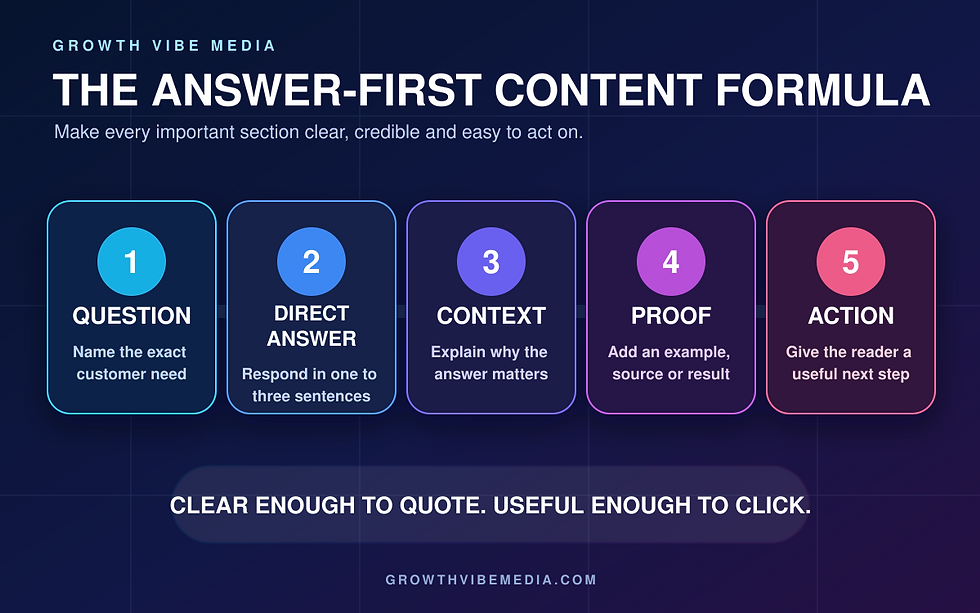
Do not make readers scroll through five paragraphs before receiving a useful answer. Lead with a concise response, then explain it.
A strong AEO-friendly section often follows this structure:
Question: Use a natural-language question as the heading.
Direct answer: Respond in one to three sentences.
Context: Explain why the answer matters.
Proof: Add an example, source, result, process, or expert observation.
Action: Tell the reader what to do next.
For example:
How often should a small business post on social media? A small business should choose a posting schedule it can maintain consistently while still producing useful content. Three strong posts that support a clear goal can outperform seven rushed posts with no strategy. Start with quality, measure the response, and increase frequency only when the workflow is sustainable.
That answer is clear enough to stand alone, yet specific enough to make the reader want the deeper explanation.
3. Add information only your brand can provide
Generic content is easy to reproduce. First-hand experience is not.
Google’s current generative search guidance recommends creating expert-led, non-commodity content that adds value beyond common knowledge (Google Search Central).

Strengthen your content with:
A result from a real campaign
A mistake your team corrected
A before-and-after example
A screenshot or original visual
A client question you hear repeatedly
A practical template or checklist
A clear opinion based on professional experience
A local or industry-specific insight
Instead of publishing “10 Social Media Tips,” publish “The Three-Post Weekly System We Use When a Small Business Has Limited Time.” The second idea is more specific, defensible, and useful.
4. Make your expertise and brand identity clear
Answer engines need context about who created the content and why that source may be credible.
Every important article should make the following easy to identify:
The author or organization
Relevant experience or credentials
The date published and updated
The services, topics, or industries connected to the brand
The geographic area served, when relevant
A clear About page and Contact page
Consistent names, descriptions, and links across platforms
If your website calls the company “Growth Vibe Media,” but your profiles use several unrelated names and descriptions, platforms have to work harder to connect those identities. Consistency helps people and machines understand the brand.
5. Build pages that are easy to scan and interpret
Clear structure improves the experience for readers and makes important information easier for search systems to identify.
Use:
One descriptive H1 title
Question-based H2 and H3 headings
Short paragraphs
Numbered steps for processes
Bullet points for checklists
Comparison tables when choices matter
Descriptive image filenames and alt text
Internal links with meaningful anchor text
A short summary near the beginning
FAQs that answer genuine follow-up questions
Structured data can also provide explicit information about a page. Google recommends JSON-LD in many situations because it is generally easier to implement and maintain, but the markup must match the visible content. Structured data can support understanding and search features, but it does not guarantee visibility (Google Search Central).
Use schema as a clarity tool, not a shortcut.
6. Protect technical discoverability
Excellent content cannot perform if platforms cannot access or index it.
At minimum:
Confirm important pages are indexable.
Keep the XML sitemap current.
Use canonical URLs correctly.
Fix broken links and redirect chains.
Make important content available as text, not only inside images or videos.
Link new articles from relevant existing pages.
Check mobile usability and page speed.
Maintain accurate business details on search and map profiles.
Review robots.txt and CDN settings before blocking crawlers.
For ChatGPT search visibility specifically, OpenAI says publishers should allow OAI-SearchBot and requests from its published IP ranges. OAI-SearchBot controls search discovery separately from GPTBot, which relates to potential model training (OpenAI crawler documentation).
This distinction matters. A business can make an informed choice about search visibility and model-training access instead of treating every AI crawler as the same thing.
7. Turn one authoritative page into a content ecosystem
Publishing the article is the beginning, not the end.

Create one high-value “source page” on your website, then distribute its ideas across the platforms your audience already uses.
For example, a guide titled How to Build a 90-Day Social Media Strategy could support:
Reel: “The mistake that makes a 90-day plan fail by week two”
Carousel: “Five content pillars every small business needs”
LinkedIn post: “Why posting more is not a strategy”
Email: “The 30-minute weekly content review”
Pinterest pin: “90-Day Social Media Planning Checklist”
FAQ article: “How far ahead should social media content be planned?”
Link relevant posts back to the full guide when the platform and context allow it. The website holds the complete answer. Social content creates discovery, demonstrates expertise, and gives the idea more opportunities to reach the right person.
A simple 30-day implementation plan

Week 1: Build the foundation
Choose one service or offer to support.
Collect 10 real customer questions.
Group the questions by awareness, consideration, and decision stage.
Select one question that deserves a complete guide.
Check whether your website can be crawled and indexed.
Week 2: Create the source content
Write one comprehensive article.
Place the direct answer near the top.
Add original examples, proof, and trusted sources.
Include clear headings, a table, steps, and FAQs where useful.
Link to relevant service, product, About, and Contact pages.
Week 3: Distribute the expertise
Create two short-form videos.
Create one educational carousel.
Publish one opinion-led LinkedIn post.
Send one email that links to the guide.
Update one older article with a relevant internal link.
Week 4: Measure and improve
Review impressions, clicks, and queries in Google Search Console.
Check which social posts produced profile visits, saves, and website actions.
Review leads and conversions connected to the topic.
Strengthen any section readers frequently ask about.
Add a new example, visual, or FAQ based on audience response.
Repeat the process with a connected question. Over time, you will build a topic cluster instead of a collection of disconnected posts.
How to measure SEO and AEO performance

Rankings still matter, but they are only one part of visibility.
Track a combination of:
Organic search impressions and clicks
Search queries and landing pages
Non-branded and branded searches
Engagement with key pages
Email sign-ups, inquiries, bookings, and sales
Referral traffic from AI and discovery platforms
Pages cited in AI-generated answers
Assisted conversions across the customer journey
OpenAI states that ChatGPT search referral links automatically include utm_source=chatgpt.com, which can help publishers identify that traffic in analytics (OpenAI Publishers and Developers FAQ).
Microsoft also introduced AI Performance reporting in Bing Webmaster Tools in 2026. It can show total citations, cited pages, grounding queries, and citation trends across supported AI experiences (Bing Webmaster Blog).
Do not evaluate AEO only by whether one tool mentions your brand on one day. AI answers can vary. Look for patterns in qualified discovery, citations, branded demand, and conversions over time.
Common SEO and AEO mistakes to avoid
Publishing generic AI content without original value
AI can support research, outlining, and production, but a polished article is not automatically a useful article. Add judgment, examples, fact-checking, and a distinct point of view.
Targeting keywords without understanding the decision
Traffic is not valuable when the content attracts people who will never need the offer. Match the topic to a real audience problem and a logical next step.
Hiding the answer
Long introductions and vague language frustrate readers. Give the answer first, then earn attention with depth.
Treating schema as a ranking guarantee
Structured data can clarify meaning and support eligible search features. It cannot replace strong content, technical access, or credibility.
Creating separate content for every minor keyword variation
One well-organized resource can answer several closely related questions. Avoid thin, repetitive pages that compete with each other.
Measuring reach without business results
High impressions may look impressive, but qualified inquiries and sales matter more. Connect content metrics to the outcome the business actually needs.
Frequently asked questions
Is AEO replacing SEO?
No. AEO depends on many of the same foundations as SEO, including crawlability, relevance, clarity, authority, and useful content. AEO adds a stronger focus on direct answers and citation-ready information.
How do I optimize content for AI search?
Answer a specific question clearly, organize the page with descriptive headings, add original expertise, support claims with reliable sources, keep the page current, and make sure relevant crawlers can access it. Avoid shortcuts that add markup or files without improving the user’s experience.
How can a business appear in ChatGPT search?
Publish useful, accessible website content and make sure OAI-SearchBot is allowed in robots.txt and by the site’s hosting or CDN configuration. Inclusion or ranking is not guaranteed, but blocking the search crawler can prevent pages from appearing as cited search results.
Does every blog post need FAQ schema?
No. Add FAQs when they answer genuine follow-up questions. Any structured data should match visible content and follow the rules of the platforms you want to appear on. Schema is not required for a page to be useful or eligible for every AI search experience.
Can social media improve SEO and AEO?
Social media can expand content distribution, create branded demand, attract links, and help more people discover a brand’s expertise. Social engagement is not a substitute for website SEO, but social and search strategies can strengthen the same customer journey.
How long does SEO and AEO take to work?
There is no universal timeline. Results depend on the website’s current authority, technical health, competition, topic, content quality, and consistency. Measure progress over months, improve content from real data, and focus on qualified visibility rather than instant rankings.
The future of visibility is answerable, searchable, and useful

The goal is not to write for an algorithm. The goal is to become the clearest and most credible source when your ideal customer has a question.
Build content that search engines can discover, answer engines can understand, and real people can use. Lead with the answer. Add experience that cannot be copied from a generic summary. Connect every piece of content to a meaningful next step.
That is how SEO and AEO become more than marketing terms. Together, they create a visibility system that can keep working long after you press publish.
Ready to turn your ideas into a consistent strategy? Use Create & Conquer: A 90-Day Social Media Strategy Planner to map your goals, content pillars, campaigns, and weekly execution in one place.

Want a tailored visibility strategy for your business? Work with Growth Vibe Media.

Written by Kailey Oliver
Digital Marketing & Communications Specialist • Bestselling & Award-Winning Author
Kailey Oliver is a digital marketing and communications specialist, best-selling and award-winning author whose work has been featured in numerous magazines and publications. She is the recipient of the 2026 Canadian Choice Award for Author – Ottawa.
Kailey shares practical insights on branding, SEO, AI, content marketing, social media, and online visibility to help businesses, entrepreneurs, authors, and creatives build memorable brands and grow with confidence. When she's not reading, writing, or creating, you'll often find her on, in, or by the water, or exploring the world through solo travel adventures.


Comments